


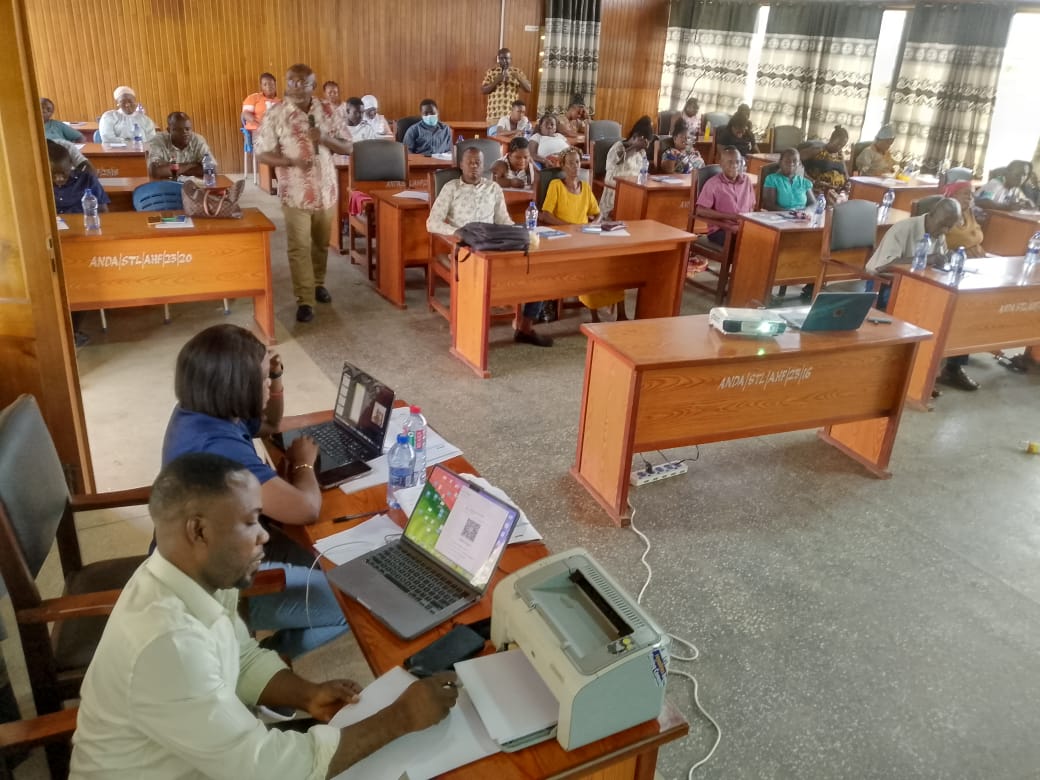
When community members, local officials, and mining representatives gathered at the Mawuli Hotel in Obuasi, the energy in the room was unmistakable. For the first time, many of them were engaging with land compensation laws in their own language, Twi. The new guide launched by the Centre for Public Interest Law (CEPIL) with support from Oxfam in Ghana made this possible.
The engagement on the Twi Guide on Land Compensation Laws and Legal Support for Human Rights and Environmental Violations was not just another check-list activity. It was a bridge between communities and the law, turning complex legal concepts into something ordinary people could finally claim as their own.
“For years we’ve lived beside mining operations without understanding what the law actually says about our rights,” said Zenabu, a participant from Kenyasi. “Now, at least, we can read it ourselves and ask questions confidently.”
From Legal Texts to Real-Life Empowerment
The event, held on September 29, 2025, brought together 44 participants(22 females and 20 males), including municipal officials, traditional leaders, members of affected communities, civil society organizations, and representatives of the Commission of Human Rights and Administrative Justice (CHRAJ) and AngloGold Ashanti (AGA).
CEPIL’s Legal Advocate, Mr. Alhassan Iddrisu, opened the session by reminding participants that legal empowerment begins with access. “When laws are written in English only,” he said, “they exclude the very people they are meant to protect. Translating this guide into Twi is not just about language. It is about justice.”
The discussions revealed deep frustrations. Community members spoke of unsafe water sources, slow compensation processes, and a lack of communication from companies. Yet, the room was also filled with a growing sense of confidence that change was possible.
“We are not against development,” said Hannah, a mother of three from Bensire. “But we want our children to grow up safe, with clean water and fair treatment. Knowing the law helps us demand that.”
Breaking Down the Law in Twi
The highlight of the day was a presentation by Mr. Richard Ellimah, Lead Consultant from the Center for Social Impact Studies (CeSIS). Speaking in Twi, he explained key legal frameworks like the Land Act (2020), Minerals and Mining Act (2006), and Compensation and Resettlement Regulations (2012), using examples everyone could relate to.
“The Constitution is clear,” he said. “No one should lose their land without fair, prompt, and adequate compensation. That is not a privilege. It is a right.”
Mr. Ellimah’s approach helped participants see how these laws connect directly to their daily lives. He also explained international standards such as the World Bank’s Resettlement Guidelines, showing how Ghana’s mining practices can meet global fairness benchmarks.
“This guide is a power tool,” he added. “Use it to ask questions, to negotiate fairly, and to hold institutions accountable.”
Turning Grievances into Action
The group discussions revealed many community concerns, such as polluted water, destroyed farmlands, and lost livelihoods. But they also sparked a new kind of conversation, one that focused on solutions.
When participants shared that court processes often feel expensive and intimidating, Mr. Iddrisu introduced Alternative Dispute Resolution (ADR) as a practical option. “Not every case must go to court,” he explained. “Mediation and negotiation can also achieve justice, sometimes faster and with less fear.”
“For once, I feel like the law is on our side,” said Aaron Noah(community), who spoke about the impact of displacement on local families. “Even if we cannot afford a lawyer, CEPIL is showing us that we still have a voice.”
A Shared Commitment to Justice
At the end of the training, participants reflected on what they had learned and how they would apply it. CEPIL’s Monitoring, Evaluation and Learning (MEL) Officer, Ms. Mercy Danso, led an evaluation where participants shared what they found most useful. Many spoke about their new motivation to educate others in their communities.
“I’m taking this guide back home,” said Esther Kusi(community). “We’ll meet as a group and read it together. If we understand our rights, we can protect our land.”
In her closing remarks, Ms. Naa Deedei Ayerson, CEPIL’s Program Officer, thanked participants for their active involvement. “This is just the beginning,” she said. “Every question you asked today helps us design better programs, and every story you shared helps us advocate more strongly for change.”
A Lasting Impact
The Obuasi session was more than a mere engagement. It was a step toward justice and shared empowerment. By simplifying the law, amplifying local voices, and fostering open dialogue, CEPIL is helping communities move from frustration to informed action.
As participants posed for a group photo at the end of the day, smiles replaced skepticism. Behind those smiles was a quiet but powerful shift, the realization that knowledge itself can be a form of resistance and that with the right tools, justice is no longer out of reach.
“Before, we waited for others to speak for us,” one participant said. “Now, we can speak for ourselves.”


